
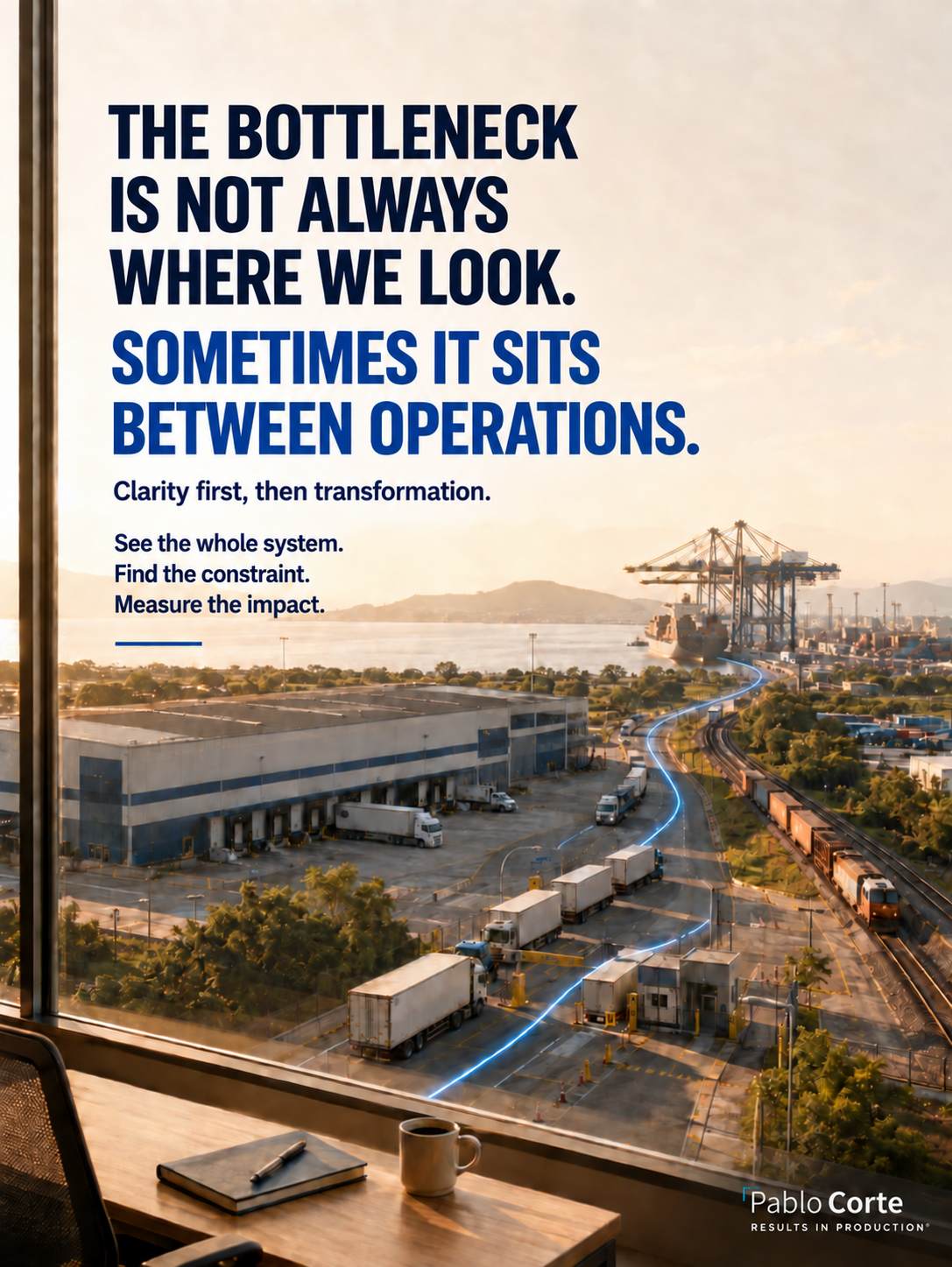
Maersk’s September update for Latin America highlights two developments that initially appear to be logistical: new regional connections between Mexico, Panama and Ecuador, and progress on the Capricorn Bioceanic Corridor between Brazil, Paraguay, Argentina and Chile. The report also cites an Inter-American Development Bank estimate that the region could increase its annual exports by more than US$78 billion if it captures greater demand associated with nearshoring.
But the opportunity does not depend only on having more ports, roads or capacity. It depends on the nodes operating as a flow: suppliers, borders, transport, depots, terminals, information, decisions and customers. When one of those interfaces is delayed, the entire system feels the constraint.
This logic extends beyond logistics. In manufacturing, services, mining or an administrative operation, the most expensive problem may not be inside an activity. It may be between two teams, two systems or two decisions that no one is examining end to end.
The Theory of Constraints offers a practical warning: improving a part that does not limit the flow does not necessarily change the system’s result. Six Sigma and continuous improvement help make variation, rework and waiting visible, but they require an E2E view to distinguish the symptom from the actual constraint.
So what?
For a C-level executive or board, the risk is funding efficiency initiatives on several fronts without improving the bottleneck that constrains performance. Investments are made and local progress is reported, yet cycle time, service level, effective capacity, cost and working capital do not improve.
My take: before designing a solution, I would start by taking a complete picture of the flow. Understand where demand enters, which decisions are made, where work waits, what is reworked, which information is lost and which constraint ultimately determines the result for the customer.
Only then would I decide what to simplify, standardise, balance, automate or transform. Transformation gains meaning when it focuses on the constraint and thereby changes a measurable result, rather than simply attacking the most visible activity.
Clarity first, then transformation.
A NECESSARY SEQUENCE
Clarity first,
then transformation.
PABLO CORTE · CORTE CONSULTORES
Executive experience and consulting applied to understanding processes, accountability, evidence and results.
KEEP OBSERVING
Other related ideas.

24 JUL 2026
Mastering Flow: To Deliver More Projects, Start Fewer
Your portfolio is not slow because it lacks resources. It is slow because too many projects were opened at the same time. Mastering Flow brings the Theory of Constraints to the project portfolio: to deliver more, start fewer.
READ THE IDEA →
17 JUL 2026
The Problem Is Not Strategy. It Is Execution.
A polished deck, a three-year roadmap, and eighteen months later the company operates exactly as before. The problem is usually not strategy. It is that no one truly knows how the company operates today.
READ THE IDEA →